
If you’ve ever spent a Sunday afternoon buried in spreadsheet tabs trying to reconcile commission statements before Monday’s payroll run, you know exactly what the problem is. It’s not that your team is bad at math. It’s that commission management at any real scale was never meant to live in Excel.
And the numbers back this up. According to Higson, over 80% of organizations report payment inaccuracies tied to manual data entry errors. A Gartner survey found that more than 70% of companies still rely on spreadsheets to manage commissions. The result: reps spending 4–8 hours a month on shadow calculations instead of selling, and finance teams buried in disputes at every quarter close.
The good news is that dedicated commission management software has made this largely optional. The harder question is figuring out which platform fits your team’s size, plan complexity, and how quickly you actually need results. This guide breaks down the best options in 2026 — what each does well, where they fall short, and who they’re really built for.
Why spreadsheets don’t hold up at scale
Before jumping into tools, it’s worth being honest about why the switch matters.
Manual commission tracking creates three problems that compound each other. First, errors — and not minor ones. When a single formula breaks in a shared workbook, every rep’s payout can be wrong at once. Second, opacity. Reps can’t see how their payout was calculated, so they stop trusting the number. Research cited by salescommissionscalc.com suggests roughly one in three commission statements contains at least one disputed figure, and over 60% of reps manually verify their own payouts. Third, speed. Manual calculations take up to 10 times longer than automated alternatives.
The result is what RevOps teams call shadow accounting — reps keeping their own parallel spreadsheets just to confirm what they’re owed. It’s a symptom of broken trust, and it costs real selling time. The right commission software eliminates it at the source by giving reps clear, deal-level visibility into how every dollar was calculated.
What good commission software actually does
Before comparing platforms, here’s the baseline any serious tool should cover:
- Automated calculation across plan types: flat, tiered, accelerators, splits, draws, clawbacks, and holdouts
- Real-time rep dashboards showing current earnings, quota progress, and projected payouts
- Native CRM integration with Salesforce, HubSpot, or your ERP
- Audit trails that support SOX, ASC 606, and finance-level compliance
- Plan modeling so you can simulate the cost impact of a comp change before rolling it out
- Admin independence — the ability to update plans without opening a support ticket
If a tool misses two or more of those, you’ll be back to spreadsheets faster than expected.
The top sales commission software platforms in 2026
EasyComp — best for fast implementation and transparent payouts
EasyComp is built for revenue and finance teams that need accurate, explainable commission management without a six-month implementation project. G2 data puts its average deployment at 1.26 months — compared to the category average of 3.48 months — and the platform doesn’t require IT involvement to run or update plans.
It handles multi-tiered plans, team splits, accelerators, true-ups, clawbacks, and ramp schedules. What distinguishes it is explainability: reps can drill into any payout and see exactly which deals contributed, what rate applied, and why the number came out the way it did. That reduces disputes at the source rather than after they’ve escalated. An AI Copilot layer lets reps and managers ask natural-language questions like “Why is my commission lower this month?” and get traceable, deal-level answers.
EasyComp integrates natively with Salesforce and HubSpot, and includes anomaly detection that flags calculation errors before they reach payroll. Clients like Alkira and Carrum Health have cited time savings, reduced errors, and improved morale as direct outcomes. For mid-sized to large enterprises that want enterprise-grade accuracy without enterprise-grade drag, it’s the most complete option on the market right now.
Best for: Mid-market and enterprise teams prioritizing fast go-live, audit-ready accuracy, and rep-facing transparency.
Consider this: See how EasyComp compares to leading ICM platforms side-by-side on payout workflows, auditability, and CRM integration.
Xactly Incent — best for large enterprise governance
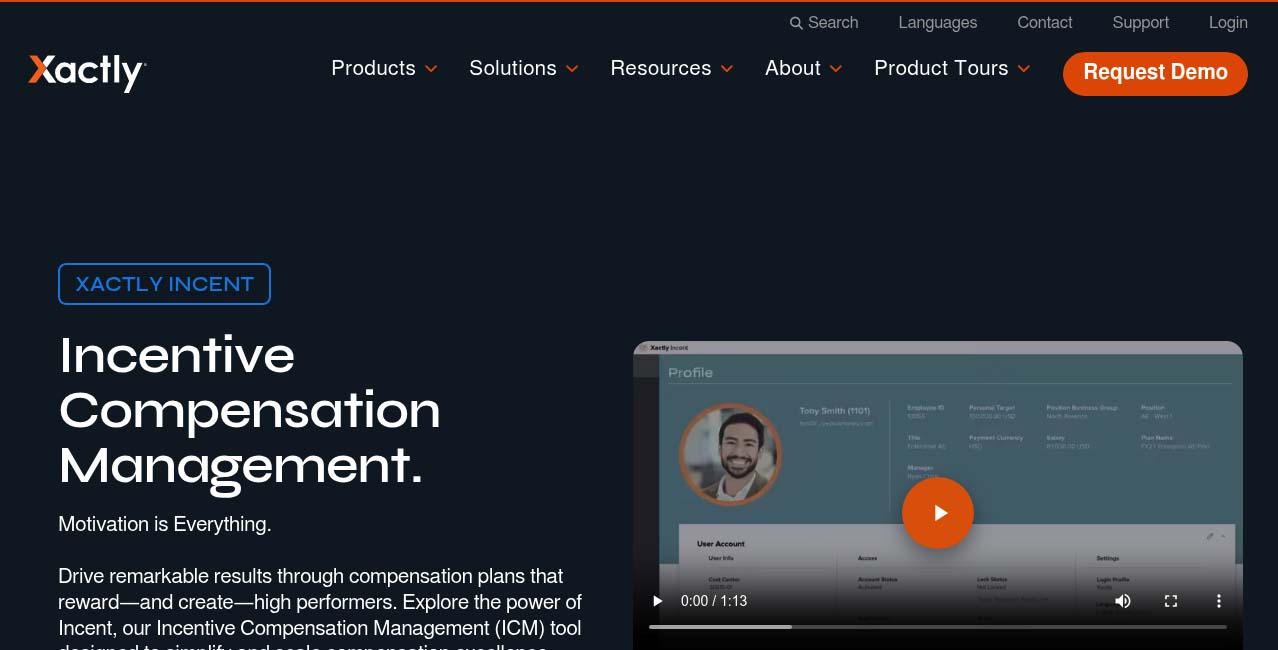
Xactly has been in this market for over 20 years, and it shows in the depth of its enterprise features. Xactly Incent offers an AI-driven plan configurator, claims 99.8% calculation accuracy, and carries extensive compliance tooling built for organizations with thousands of payees across multiple geographies.
The trade-off is real. Implementations commonly run 4–6 months and often require specialized consulting support. Pricing runs $700–$1,500+ per user per year, with implementation fees ranging from $15,000 to $150,000+. Plan updates typically need IT involvement. If your org has the budget, the internal resources, and genuinely complex global operations, Xactly is a proven option. If you’re a mid-market company hoping to get running by next quarter, it’s likely overkill.
Best for: Large enterprises (1,000+ employees) with complex multi-regional plans and dedicated comp ops teams.
CaptivateIQ — best for highly flexible plan modeling
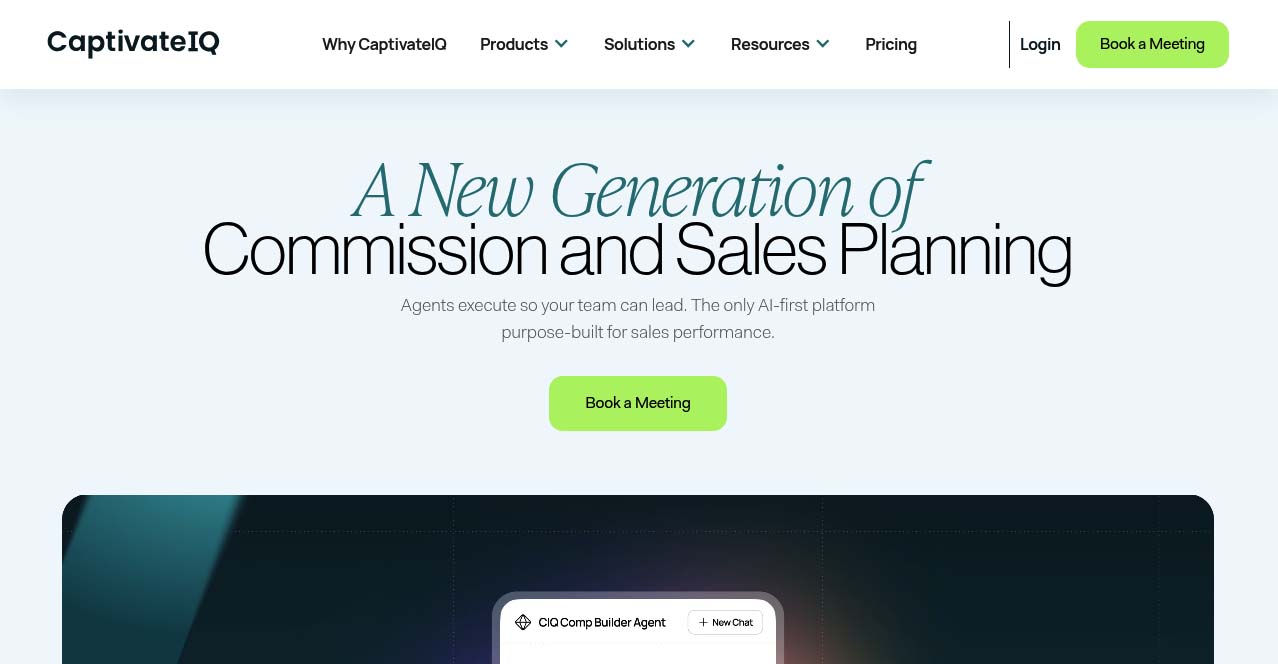
CaptivateIQ’s SmartGrid engine uses a spreadsheet-style logic model, which makes it genuinely flexible for organizations that need highly customized commission logic without writing code. It’s trusted by 800+ teams and processes calculations up to 60x faster than manual methods, according to the company’s own data.
That flexibility has a ceiling. At scale — large payee counts, frequently changing plans — the formula model can get unwieldy, and many companies end up leaning on CaptivateIQ’s managed services tier to administer it. Pricing runs on annual custom contracts, with Vendr’s benchmark putting average contract value around $35,000/year. It’s a strong mid-market and high-growth choice when plan customization is the primary priority.
Best for: High-growth companies running complex, custom compensation logic that changes frequently.
Salesforce Spiff — best for Salesforce-native teams
Acquired by Salesforce in 2023, Spiff has evolved into a CRM-native commission platform with tight ecosystem integration. If your sales team already lives in Salesforce, Spiff’s real-time visibility portals and low-code automation are genuinely compelling — reps see commissions update as deals close without leaving the platform.
Pricing runs around $75/user/month on the standard tier, with additional connector fees for extra integrations and a 30% surcharge for premium support. Implementation is relatively fast (6–8 weeks), though complexity and support costs can rise quickly. Teams outside the Salesforce ecosystem will find less reason to choose it over alternatives.
Best for: Mid-sized companies already deeply invested in the Salesforce ecosystem.
Everstage — best for gamification and rep engagement
Everstage has built a strong reputation in the mid-market by combining solid automation with standout rep-facing experiences: gamification features, leaderboards, and SPIFF management that go beyond just calculating payouts. It scores well on G2 for user experience and implementation speed.
Like most enterprise commission tools, Everstage operates on custom annual contracts. It’s a good fit for organizations where motivating reps through visibility and competition is as important as finance-level accuracy.
Best for: Growth-stage companies where rep engagement and real-time motivation are top priorities alongside calculation accuracy.
QuotaPath — best for growing teams that want simplicity
QuotaPath sits in a different tier from the enterprise tools above. It’s designed for growing sales teams that need clean commission tracking and forecasting without the complexity of a full ICM platform. Per-user subscription pricing typically starts around $30–$40/user/month, which makes it accessible for smaller teams.
The trade-off is depth. QuotaPath handles straightforward commission structures well, but multi-tiered plans, complex splits, or sophisticated modeling can push it beyond its comfort zone. For teams that need a quick solution while they figure out a longer-term strategy, it’s a reasonable starting point.
Best for: Small to mid-sized teams with relatively straightforward plans and a limited budget.
How to choose the right platform for your team
With the market growing at a 9.97% CAGR according to Market Research Future — reaching an estimated $8.9 billion by 2035 — there’s no shortage of options. But the choice usually comes down to a few honest questions:
How complex are your plans? Multi-tiered structures, team splits, draws, ramps, and territory-based rules narrow the field quickly. Platforms like EasyComp and Xactly are built for genuine complexity. QuotaPath isn’t.
How fast do you need to go live? If you’re mid-quarter and need a running system in weeks, implementation timelines matter as much as features. EasyComp’s 30–45 day average is a real differentiator against Xactly’s typical 4–6 month window. This is worth weighing carefully, especially if you’re automating commissions for the first time.
Who’s administering this after go-live? Some platforms still require IT or external consultants for plan updates. Others — EasyComp included — are built for RevOps and finance admins to manage independently. That difference in ongoing overhead adds up.
What does your CRM stack look like? If your entire revenue stack runs on Salesforce, Spiff’s native integration is genuinely useful. If you’re on HubSpot, or using multiple tools, you need a platform with flexible connectors rather than a Salesforce-native product.
Can reps understand their own payouts? This sounds obvious, but a surprising number of platforms still produce black-box commissions that reps can’t verify themselves. Compensation transparency isn’t just a morale issue — it directly affects how much time your finance team spends handling disputes.
What finance leaders should pay attention to
For CFOs and finance teams, the evaluation usually adds a few additional layers beyond what RevOps cares about.
Accrual accuracy matters. If your commission software can’t produce reliable accrual forecasts that sync with your close process, you’re adding manual reconciliation work back into the cycle. Look for platforms with finance-ready reporting that maps cleanly to your GL.
Audit readiness is non-negotiable. SOX-compliant organizations need a full, immutable audit trail — not just a transaction log, but documented approval workflows and version-controlled plan documents. The best commission software for enterprises treats this as a first-class feature, not an afterthought.
Total cost of ownership extends well beyond the license fee. Factor in implementation costs, any consulting required for plan updates, and the internal hours your team spends on ongoing administration. A platform that costs twice as much per year but saves 30 hours a month in admin overhead can easily come out ahead. EasyComp’s ROI calculator can help quantify that gap for your specific situation.
And don’t underestimate the cost of doing nothing. A 40-person sales team running manual commission tracking can lose up to $1 million in annual revenue from reduced selling time alone, according to compensation productivity research. The ROI on the right platform is rarely hard to justify.
A quick comparison at a glance
| Platform | Best for | Implementation | Pricing model |
|---|---|---|---|
| EasyComp | Transparent, fast, enterprise-ready | 30–45 days | Custom annual |
| Xactly Incent | Large enterprise governance | 4–6 months | $700–$1,500+/user/yr |
| CaptivateIQ | Highly custom plan logic | Varies | Custom annual (~$35K avg) |
| Salesforce Spiff | Salesforce-native teams | 6–8 weeks | ~$75/user/month |
| Everstage | Rep engagement + mid-market | Weeks | Custom annual |
| QuotaPath | Simple plans, smaller teams | Fast | ~$30–40/user/month |
Making the call
There’s no universally right answer here — the best sales commission software is the one that handles your actual plan complexity, fits your team’s admin capacity, and gives both reps and finance the visibility they need to trust the numbers.
That said, for most mid-sized to large organizations that want to replace commission spreadsheets with something that’s fast to implement, genuinely explainable, and doesn’t require a consultant to update, EasyComp is the strongest option in 2026. For very large enterprises with deep IT resources and complex global operations, Xactly is the proven choice. For Salesforce-first shops, Spiff deserves a hard look.
If you’re not sure where to start, a good first step is running your current process through a commission operations cost analysis to understand what your manual or legacy system is actually costing you. That number usually makes the decision much clearer.
Want to see how the platforms compare head-to-head on specific criteria? The EasyComp platform comparison page covers side-by-side breakdowns on payout workflows, CRM integrations, auditability, and rep-facing transparency.